Status
Description
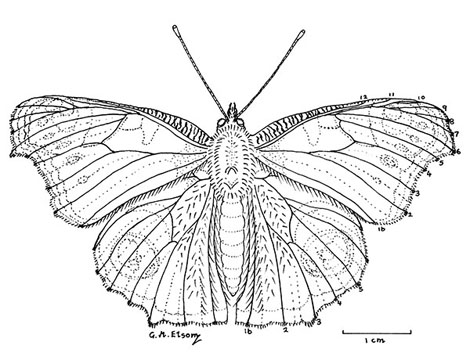
A distinctive large butterfly, which has two prominent tails on the hindwing. The upperside is a rich dark-brown with a wide yellow-brown margin, and a series of blue submarginal spots on the hindwing. The underside is a rich-brown, with white markings basally, a white band, and yellow-brown margins. Males and females are similar. The markings are unique within Europe, so can’t be confused for any other species.
Habitat Requirements
Populations of this butterfly can often be found in association with mature stands of its host tree, often along the coast, where onshore breezes may reduce the stature of these trees. This natural management of vegetation structure may aid the behavioural ecology of this butterfly, given that it is territorial and roosts in master trees, surveying its terrain, which is often comparable to forest glades. Where it is found inland, the habitat is frequently hot, dry and in open glades.
Larval Foodplants
Arbutus andrachne, Strawberry Tree Arbutus unedo, Orange Citrus x sinensis - introduced, Nicotiana glauca.
*The information provided in the tables below is based on verified sightings of the Two-tailed Pasha submitted via this website since 1st January 2021.
First and Last Sightings
| Year | First | Last/latest | # Days |
|---|---|---|---|
| 2026 | 29/04/2026 | 04/10/2026 | 159 days |
| 2025 | 04/05/2025 | 10/10/2025 | 160 days |
| 2024 | 30/04/2024 | 28/10/2024 | 182 days |
| 2023 | 27/05/2023 | 23/10/2023 | 150 days |
| 2022 | 22/05/2022 | 17/10/2022 | 149 days |
| 2021 | 29/05/2021 | 18/10/2021 | 143 days |
Number of Observations
| Year | Number of observations |
|---|---|
| 2026 | 14 |
| 2025 | 38 |
| 2024 | 86 |
| 2023 | 24 |
| 2022 | 32 |
| 2021 | 29 |
| Grand Total | 223 |
Taxonomy
- Vernacular/Common Name: Two-tailed Pasha
- Family: Nymphalidae (Rafinesque, 1815)
- Sub-family: Charaxinae (Doherty, 1886)
- Tribe: Charaxini (Guen�e, 1865)
- Genus: Charaxes (Ochsenheimer, 1816)
- Species: jasius (Linnaeus, 1767)
References
For a list of references, please see our bibliography page.